Business Phone
051 8439995, 042 35911332

051 8439995, 042 35911332
Mon-Sat: 10.00-18.00
Updated June 2026 · Source: U.S. Citizenship and Immigration Services (USCIS) · L-1A & L-1B Intracompany Transfer VisaHome› USA Visas› Business Immigration› L-1 Visa Guide 2025–2026
Immigration Guide · 2025–2026
Transfer your existing business to the world’s largest economy — no fixed investment required. Everything Pakistani business owners need to know about the L-1A and L-1B intracompany transfer visa.
Available to Pakistani Citizens
L-1A (Executives) & L-1B (Specialists)
Green Card Pathway: EB-1C Available
Spouse & Children Included
The United States — the world’s largest economy and top destination for business expansion
Min. Investment
No Fixed Amount
Max Stay (L-1A)
7 Years
Premium Processing
15 Business Days
Green Card Path
EB-1C Available
Spouse Work Auth
Yes (L-2)
Table of Contents
Introduction
The L-1 Visa is a non-immigrant U.S. visa that enables multinational companies to transfer executives, managers, or specialized knowledge employees from a foreign office to a related U.S. office. It is one of the most powerful business immigration pathways available — and unlike the E-2 Investor Visa, it is fully open to Pakistani citizens because it does not depend on treaty-country eligibility.

The L-1 Visa enables your existing Pakistani business to establish and operate a U.S. entity under your direct management.
Unlike investor visas, the L-1 does not require a fixed capital investment. Instead, approval depends on the relationship between your foreign and U.S. companies and your qualifying role within the organization. This makes it uniquely accessible for business owners and entrepreneurs who have already built a successful enterprise in Pakistan.
Why it matters for Pakistani entrepreneurs: The L-1 visa allows you to personally move to the United States to oversee your company’s U.S. expansion — and it creates a direct pathway toward permanent residency through the EB-1C Multinational Manager Green Card.
In 2025–2026, demand for L-1 petitions continues to grow strongly, particularly from technology, IT services, and consulting businesses — sectors in which Pakistan has seen remarkable entrepreneurial growth.
Visa Categories
The L-1 visa has two distinct categories. Choosing the right one from the start is critical — the wrong classification is a common cause of denial.
L-1A Visa
For business owners, directors, senior managers, executives, and managing partners who will lead and direct U.S. operations.
Max stay: 7 years · EB-1C Green Card pathway
L-1B Visa
For employees with advanced, proprietary knowledge of the company’s products, services, research, procedures, or systems.
Max stay: 5 years
Green Card Advantage: L-1A holders can pursue the EB-1C Multinational Executive or Manager Green Card — one of the fastest and most reliable employment-based paths to permanent U.S. residence, with no labor certification required.
Eligibility
Every successful L-1 petition must satisfy three requirements established by USCIS. Meeting all three is non-negotiable — partial qualification leads to denial.
01
Qualifying Corporate Relationship
Your foreign company and U.S. company must share a qualifying corporate relationship: parent, subsidiary, affiliate, or branch office.
02
One Year Employment History
You must have worked for the foreign entity for at least one continuous year within the past three years immediately before filing.
03
Qualifying U.S. Position
Your intended U.S. role must involve executive or managerial duties (L-1A) or specialized knowledge functions (L-1B).
USCIS officers evaluate each petition carefully, paying particular attention to whether the applicant’s duties are genuinely managerial or executive — or whether the role is primarily operational.
A detailed organizational chart showing the hierarchy of the company, the number of employees supervised, and the nature of decision-making authority is essential for a strong petition.
New Office Pathway
The L-1 New Office category is the most popular pathway for Pakistani entrepreneurs. It allows you to register a U.S. company, open a physical office, and then transfer yourself to the United States as the executive or manager to lead operations — all within a structured, USCIS-recognized framework.
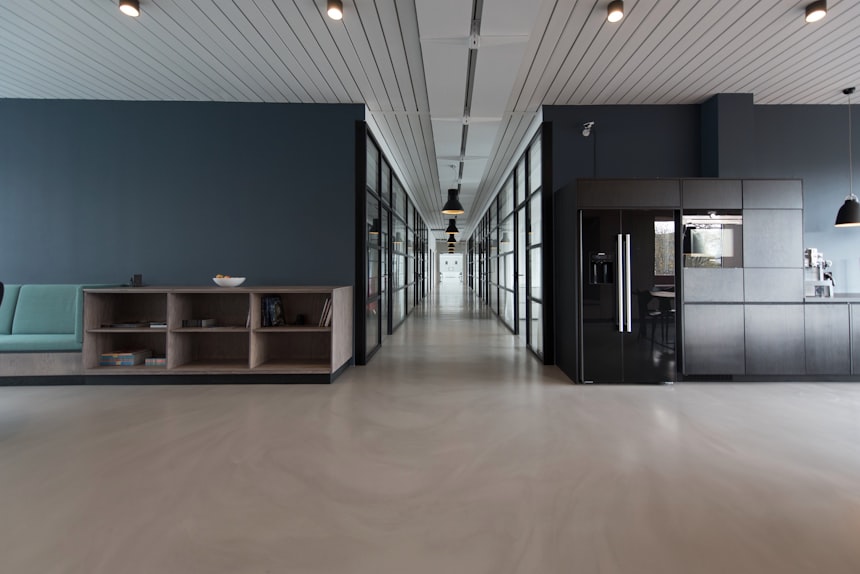
Opening a physical U.S. office is a requirement for New Office L-1 petitions — a lease agreement must be submitted with your application.
Step 1 — Register your U.S. company
Incorporate a U.S. entity (LLC or Corporation) with the appropriate corporate relationship to your existing Pakistani business.
Step 2 — Secure a physical office lease
A signed U.S. office lease is required. USCIS wants evidence of real, committed operational presence — not just a registered agent address.
Step 3 — File a comprehensive petition
Submit Form I-129 with a detailed business plan, financial projections, organizational charts, hiring plan, and corporate documents.
Step 4 — Operate, grow, and extend
New Office approvals are initially for one year. Demonstrate genuine business activity, then apply for extensions and eventually the EB-1C Green Card.
Industries that regularly achieve strong L-1 adjudication outcomes:
IT & SoftwareAI & TechnologyExport-ImportHealthcareLogisticsConsultingRetail / FranchiseManufacturing
Investment Guidance
There is no official USCIS minimum investment requirement for the L-1 Visa. However, USCIS expects compelling evidence that the company has sufficient funds to support genuine U.S. operations — including office setup, employee salaries, and ongoing operating expenses.
The practical investment amount depends heavily on your industry, your U.S. market, and the scale of operations you propose in your business plan. A boutique consulting firm in a low-cost city may operate on far less than a manufacturing company.
What matters most to USCIS is not the raw dollar amount — it is whether the financial evidence is credible and whether it supports the claimed hiring plan and business projections.
| Business Type | Typical Investment Range | Key Cost Drivers |
|---|---|---|
| Consulting Firm | $50,000 – $150,000 | Office, salaries, marketing |
| IT / Software Company | $75,000 – $250,000 | Tech staff, infrastructure |
| Logistics Company | $100,000 – $500,000 | Fleet, warehouse, operations |
| Manufacturing | $250,000 – $1,000,000+ | Equipment, facility, labor |
| Retail Business | $100,000 – $500,000 | Storefront, inventory, staff |
| Franchise | $150,000 – $1,000,000+ | Franchise fee, build-out, staffing |
Pro tip: A weak financial presentation is one of the top reasons for L-1 New Office denials. Work with a qualified immigration attorney and a CPA to ensure your financial exhibits are professional, consistent, and fully corroborate your business plan.
Documentation
A well-organized, thorough petition package dramatically improves approval chances. USCIS officers evaluate the totality of evidence — every missing or weak document creates a gap in your case.

A complete, well-organized petition package is essential — USCIS evaluates the totality of the evidence you submit.
Personal Documents
Corporate Documents
Financial Documents
U.S. Expansion Documents
For New Office cases especially, the business plan is often the centerpiece of the petition. A strong plan includes an executive summary, market analysis, competitive landscape, organizational hierarchy, 3–5 year financial forecasts, and a detailed hiring strategy demonstrating future managerial capacity.
Processing
USCIS offers two processing tracks. For most business applicants, Premium Processing is highly recommended — the fee is modest relative to the cost of delays in your U.S. expansion plans.
Standard Processing
2 – 8 months
Premium Processing
15 business days
Recommended
Consular Interview
Varies by location
Note: Premium Processing applies to the USCIS petition stage only. Consular interview scheduling at the U.S. Embassy in Islamabad or Karachi may add additional time. Plan your timeline accordingly.
Family Benefits
One of the most significant advantages of the L-1 Visa is the generous treatment of family members. Your immediate family can accompany you to the U.S. and build a life alongside your business growth.
Unlike many other visa categories, the L-2 spouse visa includes automatic employment authorization — your spouse can work for any U.S. employer without restriction.
Children may attend American public or private schools throughout the duration of your L-1 status, giving your family access to the U.S. education system from day one.
Your spouse receives an L-2 visa and is fully authorized to work for any U.S. employer. This is a significant benefit compared to many other visa categories where spousal employment requires a separate petition.
Children under 21 may accompany you on L-2 visas. They can attend U.S. public or private schools at any education level throughout the duration of your authorized stay.
Current Updates
The immigration landscape evolves continuously. Staying current on USCIS adjudication patterns can be the difference between approval and a Request for Evidence (RFE).
Increased scrutiny on New Office cases
USCIS continues to carefully examine business plans, hiring projections, financial capacity, office leases, and corporate structure. Vague or generic business plans are frequently denied or issued RFEs. Detailed, credible documentation is essential.
Organizational charts are now essential
USCIS expects a clear visual and written demonstration of the applicant’s managerial or executive position within the company hierarchy — including the number and types of employees supervised and the nature of decision-making authority.
Technology companies continue to perform strongly
Technology, software, and AI-related companies continue to achieve strong L-1 adjudication outcomes. This is a positive signal for Pakistan’s rapidly growing IT and tech sector, which has seen significant international expansion activity.
Managerial capacity must be demonstrated at extension
For New Office cases, the one-year extension review requires evidence that the U.S. business has grown sufficiently to support a genuine executive or manager — meaning actual hiring, revenue generation, and operational presence.

USCIS adjudicators in 2025–2026 apply rigorous review standards to New Office petitions — preparation and documentation quality matter more than ever.
FAQs
The most common questions from Pakistani entrepreneurs applying for the L-1 Visa, answered clearly.
What is the minimum investment required for an L-1 Visa?
There is no official USCIS minimum investment amount for the L-1 Visa. However, USCIS expects credible evidence that the company can financially support its U.S. operations, including office space, employee salaries, and business costs. In practice, investments typically range from $50,000 for a lean consulting firm to over $1 million for manufacturing operations.
Can Pakistani citizens apply for an L-1 Visa?
Yes. Unlike the E-2 Investor Visa, which requires the applicant’s home country to have a qualifying treaty with the United States — which Pakistan does not — the L-1 Visa is available to nationals of all countries, including Pakistan. This makes it one of the most accessible U.S. business immigration options for Pakistani entrepreneurs.
How long does it take to get an L-1 Visa approved?
Standard USCIS processing takes approximately 2–8 months. Premium Processing, available for an additional fee, guarantees a USCIS decision within 15 business days. Note that after USCIS approval, consular interview scheduling at the U.S. Embassy may add additional time.
Can the L-1 Visa lead to a Green Card?
Yes — particularly for L-1A holders. Executives and managers who have held the L-1A and operated a qualifying U.S. business for at least one year can apply for the EB-1C Multinational Executive or Manager Green Card. This pathway does not require labor certification (PERM), making it one of the fastest routes to permanent U.S. residence.
What happens after the one-year New Office period?
After the initial one-year New Office approval, you must file an extension petition demonstrating genuine business growth — including evidence of hiring, revenue, office operations, and your continued managerial role. Successful extension petitions can then lead to multi-year approvals and eventually the EB-1C Green Card application
Can my spouse work in the U.S. on an L-2 Visa?
Yes. Spouses of L-1 visa holders receive the L-2 visa, which includes employment authorization. Your spouse may work for any U.S. employer — they are not restricted to working for your company. This is a significant benefit compared to dependents under many other visa categories.
The L-1 Visa can be your most powerful tool for entering the American market. Begin with a consultation from a qualified U.S. immigration attorney to assess your eligibility and build a strong petition strategy.