Business Phone
051 8439995, 042 35911332

051 8439995, 042 35911332
Mon-Sat: 10.00-18.00

Canada has announced major updates to its Express Entry system for 2026, introducing new priority occupational categories and revising work experience requirements. These changes are aimed at filling labour shortages in key sectors and supporting Canada’s long-term economic and defence strategies.
The Canadian government will now prioritize candidates from three new occupational groups under category-based selection:
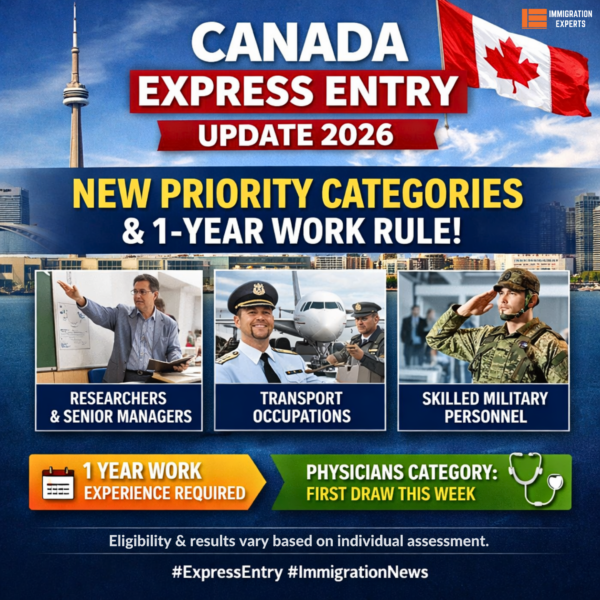
Researchers and Senior Managers with Canadian Work Experience
This category focuses on leadership and innovation roles, including university professors, teaching and research assistants, and senior managers across sectors such as construction, transportation, health, education, trade, finance, communications, and business services. Candidates with relevant Canadian work experience in these roles may benefit from targeted Express Entry draws.
Transport Occupations
The transport category has been reintroduced with an updated list of eligible occupations. This includes pilots, flight engineers, aircraft mechanics and inspectors, avionics technicians, and automotive, truck, and bus mechanics. The occupations in this new transport category differ from the earlier transport category that was discontinued in 2025.
Skilled Military Recruits
Canada is also prioritizing highly skilled military personnel for permanent residence. This category supports Canada’s defence workforce needs and includes specialized and commissioned members of the Canadian Armed Forces.
The minimum work experience required to qualify for any Express Entry occupational category has now been increased to one year.
This one year of experience must have been gained within the past three years, but it does not need to be continuous. This update replaces the previous requirement of six months of continuous work experience for some categories.
The dedicated category for physicians with Canadian work experience, introduced in December 2025, is expected to hold its first Express Entry draw shortly. This initiative is part of Canada’s effort to strengthen its healthcare workforce and address doctor shortages.
The government will continue to prioritize candidates under the following categories:
The agriculture and agri-food category has been retired. While the transport category returns, it features a newly updated list of occupations.
In addition to meeting the one-year work experience requirement, applicants under the skilled military category must also:
These additional requirements reflect the specialized nature of military recruitment pathways.
Under category-based selection, candidates working in eligible occupations have a higher chance of receiving an Invitation to Apply (ITA) for permanent residence. Since April 2024, most non-general Express Entry draws have focused on the Canadian Experience Class, meaning candidates without Canadian work experience or provincial nominations rely heavily on category-based draws to receive invitations.
This makes it increasingly important for candidates to understand whether their occupation falls within a priority category and to ensure their profiles are accurate and up to date.
Express Entry manages applications for permanent residence under three federal programs:
Applicants must meet minimum work experience requirements in TEER 0, 1, 2, or 3 occupations and demonstrate proficiency in English or French through approved language tests. Profiles are ranked using the Comprehensive Ranking System (CRS), which scores candidates based on factors such as age, education, language ability, and work experience.
These updates align with Canada’s broader strategy to address labour shortages, strengthen research and innovation capacity, improve transportation and logistics sectors, and support national defence goals. The introduction of targeted categories reflects a shift toward selecting candidates who can contribute to both immediate workforce needs and long-term economic growth.
Prospective applicants should:
